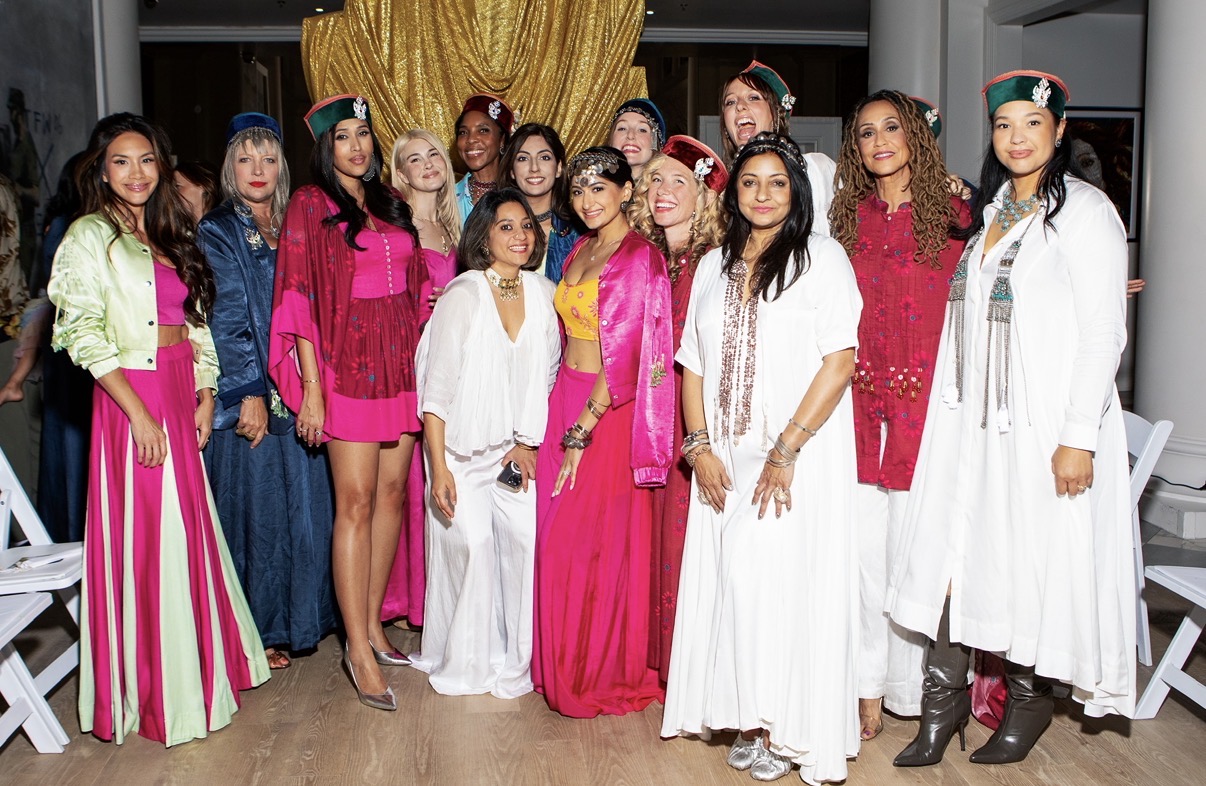
The air outside was doing what New Orleans summer air always does — thick, wet, uninvited. But something about White Linen Night this year made the discomfort feel deliberate, like the whole city agreed to sweat through one more evening for the sake of watching its artists work. It makes sense, in a way: a night dedicated to a fabric that lets you breathe, held in a season that won't let you. This night exists to honor the creatives of this city. For just one evening, New Orleans comes together to walk through the work its artists have spent the past year building.
This year, International House hosted Jay McKay for his third show at IHH, titled after Benny the Butcher's 2024 studio album Everybody Can't Go. The title explores what it means to rise to a level of success that not everyone can come along with. Each canvas hangs on the white walls of International House — a lobby that already resembles a gallery — alongside sixteen portraits of New Orleans greats: Trombone Shorty, Jon Batiste, Leah Chase, Emeril, Lil Wayne, the Marsalis family, and others. McKay finds himself among them, his own face part of that lineage on the IHH wall.
Upon entry, the hotel offered its own kind of contrast — a sweet, clean scent of lemon grass settled over you the moment you stepped inside, the polar opposite of whatever clouded your nose out on the street. It was the first juxtaposition of the night, though far from the last. McKay has always loved a good juxtaposition, and he made sure the room understood that before a single painting came into view. He arrived dressed head to toe in black, moving through a sea of white linen, sunglasses on, baseball cap pulled low to match — an outfit built less for blending in than for being found. As we were reminded last month on the 250th, he knows that we don't hail from the declaration of blending in. He made sure he'd stand out. He made sure he'd be recognized. Even the drinks were curated around him: every cocktail on the Jim Beam–sponsored menu built to reflect his work, so that the room wasn't just looking at McKay's art, it was drinking it too.
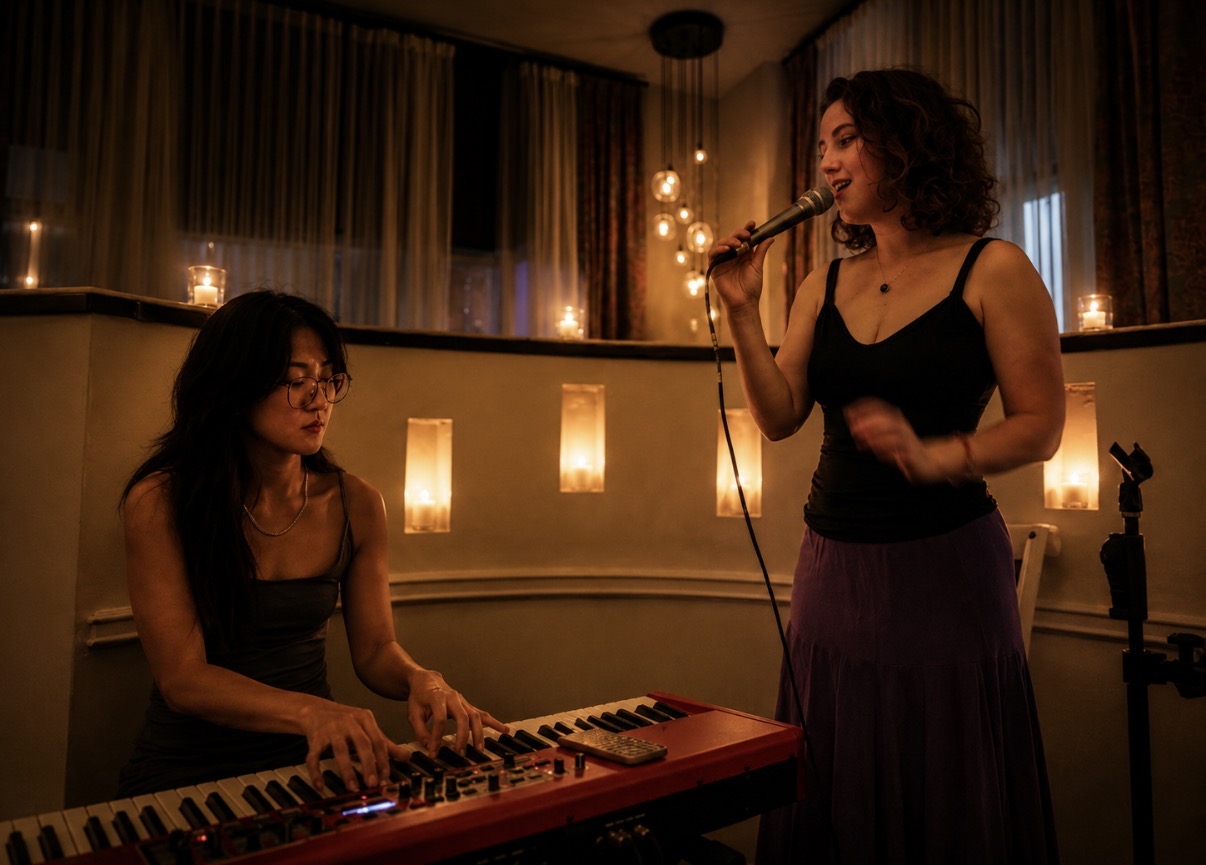
He worked the floor all night, making his rounds through New Orleans's elite with the ease of someone who knows exactly how to draw a crowd in to witness what he's spent years building. And despite naming the show Everybody Can't Go, it seemed like everybody wanted to. Over three hundred people moved through Loa and the IHH lobby at any given moment, drinks in hand, listening to Ghazi Gamali's live sound fill the room. There was never a stagnant moment. The music didn't settle into the crowd so much as move through it, bouncing off IHH's walls and back out into the room, keeping everyone in motion — a low current running under every conversation, every glance toward the walls.
But McKay's paintings seem to argue with their own title. Although the exhibition is called Everybody Can't Go, his canvases are populated by the opposite of scarcity — over a hundred heads crowded into a single frame, again and again, until the room itself starts to feel full past capacity.
Walk it long enough, and the contradiction stops feeling like a contradiction. It starts to feel like the point.
Take the piece hung near the lobby's western wall — a car interior, dashboard gauges glowing faint against the black, telephone poles and a bruised blue sky visible through the windshield glass. It would read as a quiet, almost mundane scene if not for the side mirror. Inside that small convex frame, McKay has packed a hundred faces shoulder to shoulder, rendered in the same tight grayscale strokes he uses throughout the show. One figure near the bottom raises a hand-lettered sign into the glass: "CAN I COME?" It's easy to miss on a first pass — the mirror is small, the crowd inside it smaller still — but once you see it, the whole painting reorganizes around that question. You're not looking at a car. You're looking at the view from the front seat of somebody's rise, the crowd behind you compressed into something you only catch in glances, in mirrors, in the rearview.
Elsewhere, in a canvas McKay calls "Too Crowded," he strips the scene down to almost nothing — a wall of matte, unbroken black taking up the top two-thirds of a six-foot square, the crowd pushed low and scratched into the surface in white and pale grey, like chalk on a blackboard. Where the mirror painting hides its crowd inside a detail, this one buries the viewer in negative space instead, daring your eye to sit in all that emptiness before it drops down to find the faces waiting underneath.
And then there's "Voices in Her Head" — a solid black silhouette in profile, a woman's face and shoulders cut clean against warm tan ground, her hair replaced entirely by that same churning crowd of faces, shaped this time into an afro. It's the most literal translation of the show's tension into a single image: the self as a container for the collective, an individual portrait built out of everyone she carries with her.
By the time you reach the sixteen portraits of the city's greats — Chase, Batiste, Shorty, Lil Wayne, the Marsalis family, Emeril, McKay's own face somewhere in that lineage — the crowd paintings have already told you what those portraits mean. Nobody arrives at that wall alone. Every face in McKay's crowds is somebody who didn't get the gallery lighting, the placard, the name beneath the frame. Everybody Can't Go isn't a boast about the ones who made it. It's a headcount of who didn't — painted in triplicate, hung in a house that never stops celebrating the greats of the past and present.